If you have read my dispatches over the years from the San Francisco Bay Area, you know that I was fascinated with walking the length of single streets, witnessing how the streetscape could change dramatically as it cut through the landscape. That all culminated in a journey that took me the entire 23 mile length of one street in the Bay Area, from the heart of downtown Oakland, through the suburbs of the East Bay, and ending in a field next to an oil refinery.
Now a train trip away from New York, I can’t resist doing the same. While a trip up the length of Manhattan is certainly in my future, I thought I’d start with the first of several cross sectional walks across Manhattan. So I am beginning with an obvious one, a walk which packs more landmarks into the journey than perhaps any other- 42nd Street. I should note that this is not an exhaustive block by block survey. Rather, I was drawn to a couple of recurring themes. First, the diversity of public or semi-public space along the street. And secondly, how the streetscape itself has changed, or not changed, over time.
It seemed appropriate to start on the west side, as I was coming down from our place, also on the west side of the Hudson, just 90 miles to the north. The walking/biking trail along the river here is part of the Empire State Trail, a trail I am quite familiar with, just not in Manhattan. I have walked many legs of it in the Hudson Valley, the Mohawk Valley, along the old Erie Canal near where I grew up, and its’ far west its endpoint in Buffalo. The trail is a marvelous history lesson as it burrows through historic cities and towns en route to its destination in Manhattan.
The trail is a busy promenade along the Hudson. Nearby, if you were so inclined, you could board the a Circle Line boat and circumnavigate the island. I recall doing that on my first visit to Manhattan, a 10 year old whose nausea that day was superceded by his awe of the skyline. Today, I’d be heading the other way.

The first few blocks along 42nd, heading east, are the least interesting of the walk. These blocks, from 12th to 9th, consist mostly of high rise residential buildings, a bit of retail, and one long stretch bordering a parking garage. This is technically part of Hell’s Kitchen, though I found the stretch could be more aptly named Purgatory Kitchen, as in waiting for something better. Things get more interesting crossing 9th Ave, and the stretch from 9th to 7th was my first “stop”.

Sidewalk Space- Times Square
I was too young to have experienced this stretch of 42nd’s notorious sleaze era in the 70s and 80s. The closest I got then was that aforementioned Circle Line tour. Family entertainment was very much lacking in the area back then, that is unless “The Nuns Bad Habit” was your idea of family fun. So we circled the island instead.

This stretch of 42nd Street was know as the “Deuce”, and was lined with moviehouses showing porn , grindhouse, kung fu movies, and everything in between. On the street, prostitution and the drug trade flourished. The cleanup of Times Square is well documented, and really took off during the Guiliani regime of the 90s. Today those cinemas are long gone, replaced with new buildings, remodeled theaters, and banal chain offerings such as Dave and Busters, geared to the out of town crowd. The evolution of these couple of blocks is so complete that there is barely a trace of the old Deuce.
The public space in this area, and throughout Times Square, is the sidewalk. And back in the day, as a few of these old photos suggest, there was ALOT happening on the sidewalks, with plenty of “wares” for sale if you catch my drift. In essence, the sidewalks housed the merchandise. There were still tourists then so to speak, cruising the street, most certainly not looking for a blooming onion at Outback Steak house.
I enjoy finding layers of history in a place, its’ tree rings if you will. In these few blocks, one of the few such spots would be Holy Cross Church, which sits between 8th and 9th:

This is the oldest building on 42nd, and dates to 1870. I tried to imagine the juxtaposition of this church to the mayhem along 42nd back then. The stragglers that might have wandered in from those sidewalks of the “Deuce”, and the priests who no doubt administered to Times Square denizens. I had hoped to pop into the church and have a look, but sadly, it was closed, the gate out front padlocked. It could have been part of my narrative on shared public space along 42nd. Well, here apparently is what I missed:

The church is the exception to the rule along this stretch of 42nd, as most of what was once there is long gone, save the church, an adjacent apartment building, and the hulking presence of the Port Authority Bus Station across the street. Perhaps the most dramatic preservation of new an old was the Empire Theater. It had seen better days by the late 1970s, when this photo was taken. It’s the building that was showing “Ghetto Freaks” on this day, a film I have not seen.

As part of the redevelopment of the block between 7th and 8th, the handsome neo-classical facade of the theater was picked up and moved one block, and now signals the entry to an AMC multi-plex. It is a welcome bit of dignity amidst the visual noise here, as nearby, Madame Tussaud’s and Dave and Buster’s scream for your entertainment dollar. I am sure one can argue the clean-up was for the best- but for me, something was lost in the process.

Civic Space- Bryant Park and the Library
The intensity of Times Square is way too much for me. Crossing 6th Ave and making it to Bryant Park offers a spacial reprieve, a transition away from the sensory overload that is Times Square. On the day I visited in late October, a good sized chunk of the park was fenced off, as construction was underway for the Christmas market,(is that really not that far away??), so one couldn’t enjoy the full park. This is a very busy park, offering as it does this rare bit of open space for the mid-town inhabitant. Apparently, back in the 70s, the park, with its proximity to the Deuce, was regarded as a dangerous place to be avoided, particularly at night. A restoration of the park led by the Bryant Park Restoration Corporation led to a clean-up and renovation of the park, the fruits of which could be enjoyed starting in the 90s. Having passed on the offerings at Dave and Buster’s, I opted for a mid-walk hot dog and a seat on a bench, which were hard to come by on this beauutiful fall day.
One of the perks bonus of these Manhattan parks is that it gives one vistas from which you can appreciate whole buildings. And from my seat, I had a lovely view of the American Radiator Building, seen below. Dating from 1924, and designed by Raymond Hood, it was the headquarters for the manufactuer of those ubiquitous heating elements seen in millions of old urban apartments. I have not so fond memories of my first studio apartment in San Francisco, and its radiator which never seemed in tune with the climactic needs of that day. (And for God’s sake, DO NOT TOUCH IT!).

The building features a distinctive black brick and gold trim palette that beautifully highlights its stepped massing and gothic styling.With the park providing a forecourt for such views, it became a popular subject for painting. None other than Georgia O’Keefe, who spent much of the 20s and 30s living with the photographer Alfred Stieglitz in Manhattan, painted it. Here is her whimsical rendering of the building from 1927, probably sketching it not far from where I sat now.

Of course there are not radiator salesmen housed there any longer, they left quite a few decades ago. Today, the building, like many old headquarters of bygone companies (Sears!,Woolworths!,General Electric!) has found a new life as the luxury Bryant Park Hotel. But surely it must still have radiators.
Of course, no stop at Bryant Park is complete without ducking into the adjacent beaux-arts masterpiece that is the New York Public Library. Because it was sited to enter along Fifth Ave, it somewhat turns its back to Bryant Park.Nonetheless, taken together, this 4 block square in the middle of Manahattan creates a grand civic moment.

Transit Space- Grand Central Station
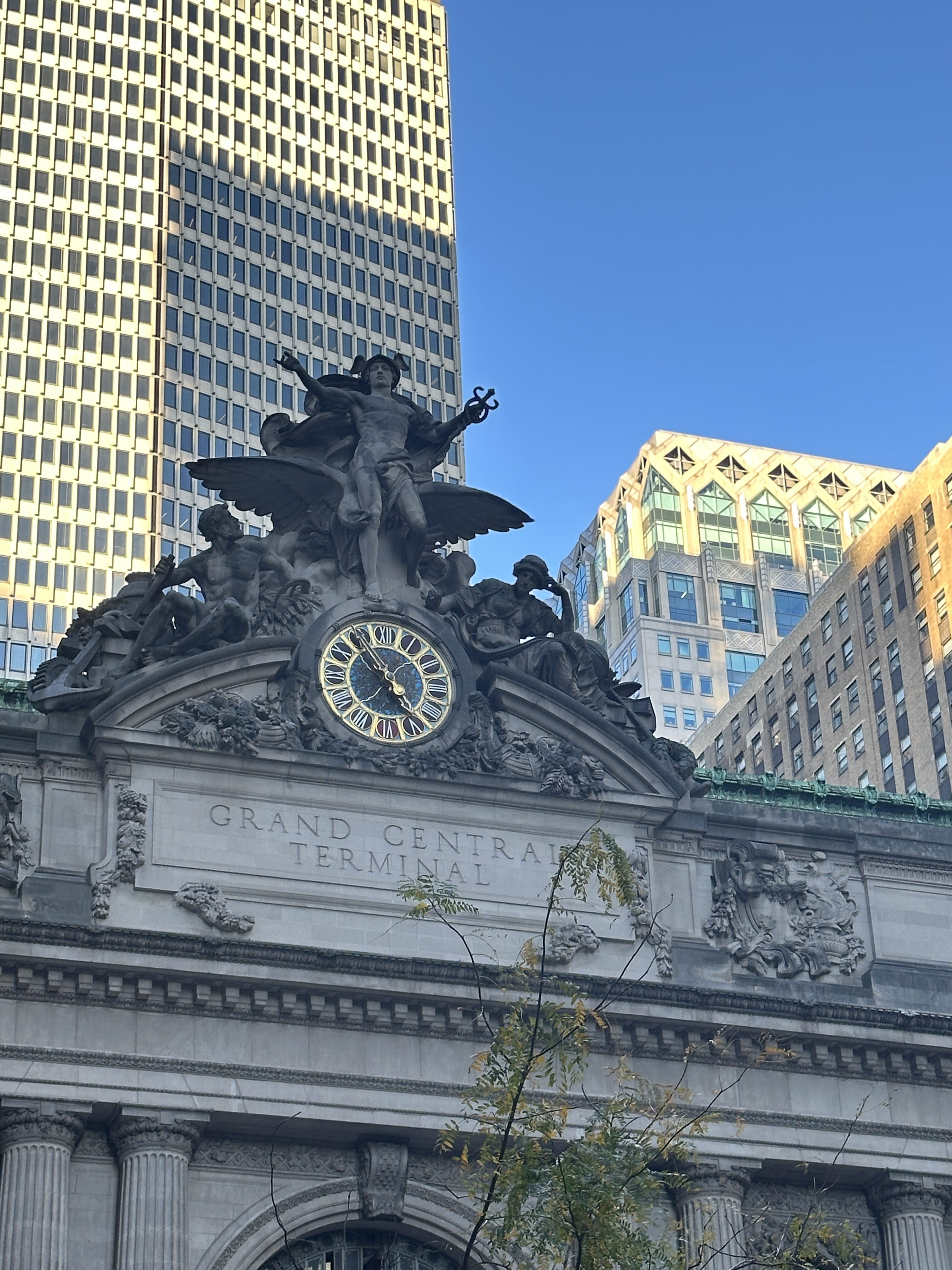
The grande dame of public spaces along 42nd, and perhaps all of Manhattan for that matter, is the main hall of Grand Central Station. We are fortunate enough that our journeys into Manhattan from the Hudson Valley take us to this landing spot, via the Metro North Railroad. The exhilaration of arriving in the grand hall is in part set up by what precedes it on the train; an interminable 40 block slog in utter darkness, through the tangle of tracks that lead to the station. Finally, the doors open, and you are swept up by the wave of fellow passengers along the sweaty platform, until you arrive at the great hall. What one experiences first is the sound, the growing din of the crowd in the hall. Then once you have arrived, you are thrust into an urban symphony, as commuters criss-cross, dodging the tourists and gawkers, all the while miraculously avoid collisions. Stopping to take it all in is best done off to the side, or better yet, from the mezzanine above.
I can’t think of a more magnificent way to enter a city. No matter how many times I take the train in , my pulse quickens as I arrive in this great hall, and in anticipation of the adventures that await that day in New York.

As hard as it is to believe, Grand Central, like the Deuce and the Park, was endangered. The destruction of New York’s other great transportation temple; Penn Station, birthed the landmark preservation movement here. The building’s preservation was championed by Jacqueline Kennedy Onassis, who loved the building. As one exits the building, small discreet plaque honors her, tucked off to one side of an entry.
“If we are not inspired by the past of our city, where will we find the strength to fight for her future”

Contemplative Space- Ford and Tudor City
Heading east from Grand Central, one passes multiple noteworthy buildings- the Daily News Building, the old Bowery Savings Bank Building, and of course, the Chrysler Building. My next stop was the atrium of the Ford Foundation Building, between 2nd and 1st Aves, but what lobbies along the way are spectacular:


The Ford Foundation is a private philanthropy organization founded by Edsel Ford and his father, Henry Ford. Designed by the firm of Roche and Dinkeloo and completed in 1967, the signature of this 12 story building is its extraordinary atrium that extends the full height of the building. So this space represents a different type; a privately owned public spaces, or POPS.
You actually enter the building from 43rd Street, and are required to register before entering. After passing through security, and a compressed entry, you are released into another grand space, a towering garden surrounded by 12 stories of offices. The spatial sequence not unlike the arrival into Grand Central. But the similarities end there. Not just the obvious that it is a tightly controlled corporate space. But it is a quiet meditative green space, one that seems appropriate for this philanthropic organization.

But its not just the space inside that is quiet. Returning to 42nd Street, the foot traffic by now has thinned considerably. As with many crosstown Manhattan streets, as you approach the rivers, things get quieter. The street is no longer fronted by retail, but instead what I assumed were the enclosing walls of garages for the imposing Tudor City residential complex above.
Here one can ascend steps to two small parks that bracket 42nd, and are connected via a bridge over 42nd. The bridge affords one of the more iconic street views in all of Manhattan, looking west along 42nd Street below, with the Chrysler Building dominating the view.

It is a different world here, floating above 42nd. These small parks are surrounded by the tudor-styled buildings that comprise Tudor City, a city itself consisting of 13 buildings that house about 5,000 people.
The small parks are absolutely lovely. You have to remind yourself that only a few minutes before, you had been in the din of Grand Central. Now, there are shouts coming from children in a nearby playground, and a serenade courtesy of cacophony of birds in the trees. Two women chatted on a nearby bench, one explaing to the other about her beloved Buffalo Bills (my team) chances this fall. A woman after my heart. I have to stop eavesdropping. In this moment, I decided I wanted to live here.
These are public parks at Tudor City, but because they are lifted off the ground, and surrounded by a single development, they feel more private. Quiet green swards sharing that character with the just visited Ford Foundation. You are now far from the hub bub.

Turning around , I faced the East River, the end of the walk, and my last desitination.

Global Space- United Nations Complex
Desecending from Tudor City, I crossed 1st Ave and my last stop; the United Nations headquarters. I was puzzled why the Tudor City building didn’t have big expanses of glass facing the river.

My answer came soon enough as I learned what used be on the site of the UN- slaughterhouses. The wall kept the smells at bay apparently. Too bad. This is an historical view of the site courtesy of the UN Archives.

I could devote a whole chapter just to this building or that site, but I’ll keep it brief. As other sites and cities were being considered, John D Rockefeller purchased the site and offered it to the UN, thus bringing the UN to New York, and it is hard to imagine it anywhere else. The complex was completed in 1952, perhaps the most extraordinary feat in my mind may have been getting 11 different architectural firms to co-operate on the design. The resulting mid-century International Style I think captures well that era of post-war global optimism, one that has held up well. The UN was about the future.

I had never been to the UN before, so I booked an “Architectural Tour ” , joining a collection of tourists from all over the world. But there was something else that stuck with me on this last stop. More than the architecture as it turned out, was just being around all the visitors and staff from all the over world- mingling, conferring in the lobby, or ogling at the building. All these people working together- perhaps on migrant issues here, climate change there, or aid projects everywhere. The tour wrapped up at the General Assembly. It was all in all an inspiring few hours, and amidst this toxic political environment we have found ourselves in, both in the US and around the world, this stop gave me a bit of hope. (And since this visit, we have had our mid-term elections, which taken with other global elections, suggest that just maybe there is some light on the horizon).

There is a symmetry to 42nd Street, and I suppose with many east-west Manhattan streets. Quieter west and east ends that bracket the wonderful urban mayhem in between. That interplay between the two, played out throughout New York, give the city much of its magic. And its through the public spaces on this street- be they quiet and contemplative, crowded and cacophonous, or local to global, that to me make it a city like no other.
It was time to catch my train back home, but I had just enough time to visit this spot one more time. It was a good day.
Leave a Reply