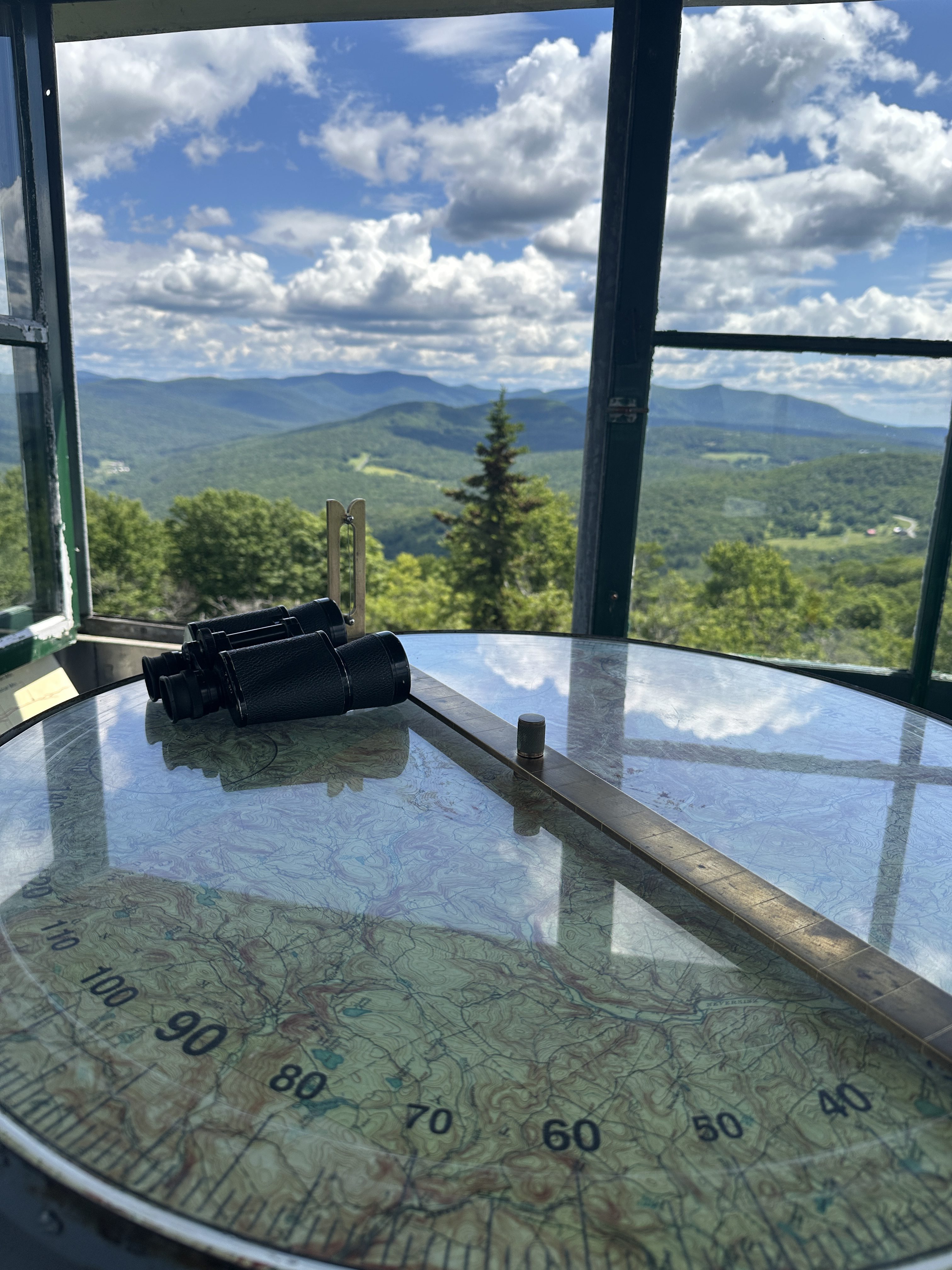
When I was kid, we used to go up to the Adirondacks every summer. These trips took two forms. Pre-teen, it was with the family, a trip to the “woods” as they were called. We would usually rent a small “house-keeping cottage” for a week on one of the multitude of pristeen lakes scattered in those woods. And later on, as a boy scout, I graduated to 2 week back-country camping trips. I fell in love with the New York State mountains on these trips- whether it be swimming in those cold lakes, hiking, or canoeing on the plentiful rivers. Equally memorable, enjoying the kitschy roadside shops, always pine-scented, that dotted the byways. In fact, it was on one of these trips that I remember my first fine dining experience, dinner at the “Knotty Pine”. Yes, the Knotty Pine. That night I ordered the trout, and it came out whole- in tact head to tail. I didn’t want to eat it.
At any rate, a couple of excursions on these trips took us to the top of a modest mountain nearby, which was topped with a fire lookout tower. In disrepair, it was closed and fenced off. I was fascinated, but my young eyes were left to imagine the view from that tiny cabin way up there, the one that seemed to be in the clouds.
Fire Lookout towers became popular in the early 20th century as a response to the many forest fires that were increasingly threatening homes and mountain villages around the country. In New York State, a fire in 1909 destroyed the village of Long Lake in the Adirondacks, and that in part sparked (no pun intended) a wave of fire tower construction.
The towers have a similar look, in part because several companies entered this burgeoning market , supplying a kit of all the necessary parts to erect a steel tower of whatever desired height. The towers were typically staffed by Fire Lookouts. When smoke was spotted, the observers used phones, or I am told- even carrier pigeons(!), to communicate the location of fires with Forest Rangers. A separate cabin was typically provided at the base of the tower for the observer to stay, tend to those pigeons, and send those alerts- by radio, phone or, hopefully, by “air-mail”.
By the 1960s, many towers were replaced by aircraft and improvements in communication that rendered them obsolete. But a number, particlarly in western states, are still staffed during the wildfire season. In the Catskills , several of the towers on this challenge have been restored, or rebuilt entirely, and now lovingly cared for.
As I settled in to New York this spring, I happened across something called the “Catskill Fire Tower Challenge”. The challenge was to ascend 8 Fire towers over the course of the year. The hikes ranged from a short walk to a tower behind a visitor center to a 7 plus mile 2,000 foot plus climb to another one, and everything in between. I was in.
The challenge has taken me to far-flung locations in the Catskills. It occurs to me I once again am “collecting” in a sense. First it was those damned Franklin mileposts, now these towers.
I have been to six so far, and here they are:


I have learned a few things on these journeys. First, hiking in the Catskills is different than in California. Trails here can be rocky, and thus slippery, because…uhhhh….it rains in the summer, unlike all summer in California. So the going can be slow. The trails are also typically in dense forest, and you can go the entire ascent without glimpses of the countryside. But the lack of those glimpses makes the payoff on the tower all the more rewarding.
Then there’s who’s at the top. At one tower, I met an observer who spends every summer weekend up on top of the mountain. He answers questions from visitors on the weekends, but otherwise has it to himself. He told me he keeps busy working on his first novel, the solitude up there spectacular. At another tower, I met an ancient hiker and his two dogs. The tower grounds included a couple of adirondack chairs that commanded a particularly great view of the valley below, and I sat down next to him and got his life story- said he lived right below us his whole life, and comes up here with his dogs once a week. We then sat quietly for a few moments, enjoying that view, until I heard snoring. He was sound asleep. In the fading autumn sun, with his dogs curled up at his feet. Another tower featured an abandoned old hotel that I was eager to explore until I was told it home to a very large community of timber rattlesnakes. That was a hard pass.
Perhaps second to getting to the tops of these towers is the journey to them. Wonderful winding country roads, small villages, roadside oddities. I have become acquainted with the villages of Andes and Neversink. Breakabean and Big Indian. I have happened upon abandoned old Catskill resorts, and even an always open self serve book store- “The Little Red Shack”.
Best of all, the arc of this challenge has taken me though the cycle of seasons here. The first hike was done in late April, a sunny day with trees still bare, and buffeted by a sharp cold wind. Come summer, the forests were now lush , green and buzzing with activity. And yes, at times replete with no shortage of bugs and humidity. And of course autumn, my favorite. I just completed the latest hike, with the hillsides beginning to glow. With leaves now falling, you can now see what’s rustling in the distance, that sound amplified tenfold.
And my goodness, I have forgotten how the smell of the eastern forest changes with the year. In April, I remember smelling nothing but earth, freshly thawed, raw. And now as we begin to turn towards winter, the forest is again pungent, this time with rotting leaves that blanket the forest floor , emitting their distinct musky aroma.
Here are a few photos.


So, there are two towers left in the challenge. The two mentioned above- the easiest and the toughest. The tough one will be a slog, and being at the highest elevation of the bunch, at a ski resort no less, may even touch winter by the time I get to it.
So I’ve kinda come full circle with the mountains of New York, nearly 50 years later. My knees are now creaky, and I bring a walking stick on those extra rocky trails. On the other hand, I am happy to now eat a whole trout, head to tail.
Leave a Reply