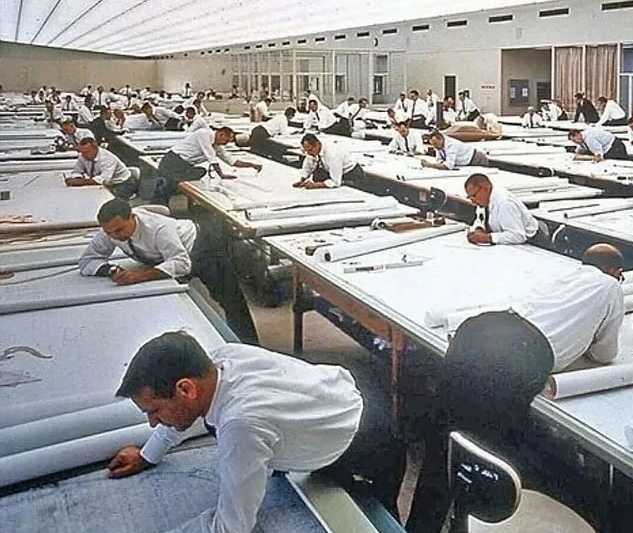
From “Working Stiff” , an upcoming recollection of career adventures ……..and misadventures.
There was a wing of our high school that was way off by itself. It was, for lack of a better term, the “Vocational” wing, and housed an auto repair garage, wood and welding shops, and photography dark rooms. And tucked into the middle of the wing was a classroom where one could learn mechanical drafting. That classroom was the first stop in my journey to be an architect.
The class was taught by Mr. Rapple, nicknamed “Blinky” by the always cruel students, as yes, Mr. Rapple was constantly blinking. (Later, after countless hours bent over drafting boards, I thought I understood why.) In the class, we learned how to illustrate mysterious industrial widgets in plan, elevation, and isometric. He was a marvelous teacher.
In college, drafting went to the next level, as we now drew buildings. We learned techniques in pencil and ink, for use on vellum, mylar, and board. We learned to construct perspectives in a very mathematically precise way. We each amassed toolboxes; with pencils and pens, t-squares and triangles, electric erasers, and shields. There were all kinds of scales, “French curves”, and tiny templates to trace toilets and sinks. Some of our instructors were supreme taskmasters, as I recounted earlier, and they were teaching us a craft that one assumed we needed for our entire career.


Plumbing template
Nothing equaled the satisfaction of completing a lovely hand-drawn building plan or section. But it came at a price. The drafting board was one’s desk, at school and now at work. One sat on a stool and hunched over the board, executing building plans and details. Architects were a chiropractor’s gold mine, as a drafting room could be filled with architects in the same position. One boss, trying rather ineffectively to inspire his troops in advance of a deadline, said he wanted to see nothing but “asses and elbows”.

Then there was managing the drawings, because designs changed constantly. Out would come the eraser, over and over, occasionally tearing through the page. It was a constant battle to keep the drawing clean, one I always seemed to be losing. I worked on some housing projects during those days and managing a drawing of a row of identical apartments was a nightmare when the client asked that a bedroom window be a foot larger.
In addition to all the above, there was the matter of what one did with those drawings when complete. First, you might need to make blueprints, which, in house, meant going into the backroom and breathing ammonia for 10 minutes. And in this pre-digital age, drawing packages needed to be assembled by hand. There were no PDFs. Consultant drawings would be delivered to the office, wreaking of ammonia, and then said package would be assembled, a minefield of paper cuts lying in wait. Finally, when all that was done, it would be delivered to its destination, say, a building department. So, there was a cottage industry around our industry— of printers, of bike messengers, and occasionally, a nurse.
The nadir of this chapter for me came in the mid-90s. I was putting together a package of drawings for a submittal to a building department, just as outlined above. As the department wasn’t far from where I lived, I told the client I would bring everything home and submit it all on my way in the morning. There was a lot of material— 4 big rolls of drawings, specification books, soils reports, and calculation books. I left the huge mound of drawings in the back floor of my car, along with boxes of bound books.
That night, we had a torrential rain, but by morning it was a lovely sunny San Francisco day. I skipped out to the car, happy to have this milestone behind me. I opened my car door… and water poured out. There must have been 6” of water in the car. As this was San Francisco, I lived on a steep hill and parked on the street, so things were much worse in the back seat. Mind you, this had never happened beforand never happened again. And I typically never left anything in my car. Apparently, the water had backed up at a plugged windshield weep.

Once I cleaned out the car I drove to work. With all the windows down, I tried to figure out if there was some sort of lie I could tell. My car was stolen seemed to be the best option. But then I could never drive to work again. I settled on the truth, and thus figured it would be my last day as an architect, either by force or my own choice. But I kept my job, having to ask everyone to do everything over.
I have often reflected on this incident. The chances of this happening on the only night I had something valuable in my car that couldn’t get wet were about as likely as being crushed by a meteorite. To this day, I can still see it, structural calculations for the project floating gently from one end of the car to the other, past a cigarette butt and a missing sock. Could only happen to me.
In college, computer-aided drafting (CAD) was an elective, and the architecture school library where I worked part time had a room devoted to one very large computer dedicated to that task. It scared me. I would go in there when I closed up and messed around with it. It would groan and click at me loudly. I didn’t like it and was sure it didn’t like me.
But by the early to mid-90s, as desktop computers became a ubiquitous office feature, nearly all architects said goodbye to hand drawing and hello to the computer age. When I started at a new job in the mid-90s, I remember being shocked to see I no longer had a drafting board. 10 years into my career, I would be learning a whole new set of skills.
Nonetheless, I still loved to sketch, and doodling design solutions by hand continued. I think with a pen in my hand. Occasionally, in the ensuing years, one would come across sole practitioners who still drew everything by hand, and it seemed refreshing. I did miss the individuality of the hand drawn plan, set against the bland uniformity of CAD. But I did not miss anything else about it. I had a chair with back, and my back felt great. My hands were free of paper cuts, and I hadn’t smelled ammonia in years.
I became an architect to be hands-on with design, so I continued to “draw” myself, albeit with the computer. Over the years, as the technology advanced, I rolled with it. In the 00’s, 2D architectural drawing programs gave way to those that built the building in 3 dimensions. And how one managed the process completely changed as well. One no longer heard the whine of the electric eraser in the office. Just hit Undo! Email allowed one to share PDFs online. And even building departments got in the act; one could now submit drawings online. No more risking drawings being saturated in a beat-up Volkswagen on a rainy San Francisco night.
In 2020, we all lurched into uncharted territory, being forced home during the pandemic. For better or worse, everyone we worked with was now a tiny square on a screen. Incredibly, it all worked. Finally, in the last couple of years, we have seen AI really take off. I have used the tools, and they can be incredible. But, like back in that library in 1985, I am a little scared of it, albeit for different, more menacing reasons. I guess we shall see how that turns out.
Looking back, it seems incredible how we did this work before computers. Really, I have no idea. Electric erasers, printers, ammonia, glue, fax machines, bike messengers, phone calls (!), and oh yes, flooded volkswagens. I remarked to a colleague that my career timing was reminiscent of a farrier at the turn of the century—(one who tended to horses’ hooves). One day he sees an automobile drive by and a few years later is now trying to learn how to repair a Model T. The arc of one’s career parallels the arc of societal change.

Last year, I was home to spend time with my 93-year-old mother. Her mornings always include a review of the day’s obituaries, and one day she mentioned a teacher from my high school passed away, and his name sounded familiar. It was Mr. Rapple. It was a lovely obituary, with many fond remembrances from some of his students. It was humbling for me to think that that class was in 1978, 47 years earlier.
My education really did begin that fall, in that classroom of the vocational wing, between the auto repair garage and the wood shop, learning how to draw industrial widgets. It said that he had taught mechanical drawing for 31 years and retired in 1991. 1991 I thought, right at the dawn of computers in architecture. He got out just in time.
I have a small project I am going to be taking on this summer. I still have my T-Square, triangles, erasing shield, and bathroom template. I am going to draw it by hand.
