On the north end of Palm Springs, before one exits the vast Coachella Valley and heads east towards Los Angeles, one passes beneath mighty Mount San Jacinto. At 10,834 feet , it towers over Palm Springs, and along with Mount San Gorgonio, forms a formidable pass , one that spawns the winds that power the many windmills seen as you leave town. The mountain is steep, and in fact has one of the steepest vertical inclines in North America. The dramatic difference in elevation accounts for the equally dramatic differences in temperature. On 110 degree summer days, the mountain can be a comfortable 75. And local residents can enjoy this change, as a tram connects the valley to the mountain, rising some 6,000 feet above the Sonoran desert below.
The tram ascends to the top via Chino Canyon. And to get to the tram, and the base of the mountain, one must first ascend a massive rock-strewn incline. The geological name for this incline is an alluvial fan, and this too, is one of the largest in North America.

Because of the dramatic escarpments that surround Palm Springs, there are few opportunities to live on the surrounding mountains. Inhabitants instead occupy the dead flat valley floor, in everything from rambling haciendas to mid century ranches, from stunning modernist estates to humble trailers. But an exception is on this alluvial fan, where one can walk from the artificially lush valley floor, up through the rocks, where the promise of a cool alpine world hovers above. This walk heads up the “fan”
As we begin the walk, west on Vista Chino Ave and Chino Canyon, one passes through the older part of town- Old Las Palmas. Here you are more apt to see Mediterranean style haciendas, low slung estates with magnificently lush landscaping.

If only you could see them. Almost without exception, they are hidden behind walls, and you are left to imagine the pleasures that lurk on the other side, whilst still admiring what’s on this side of the wall.
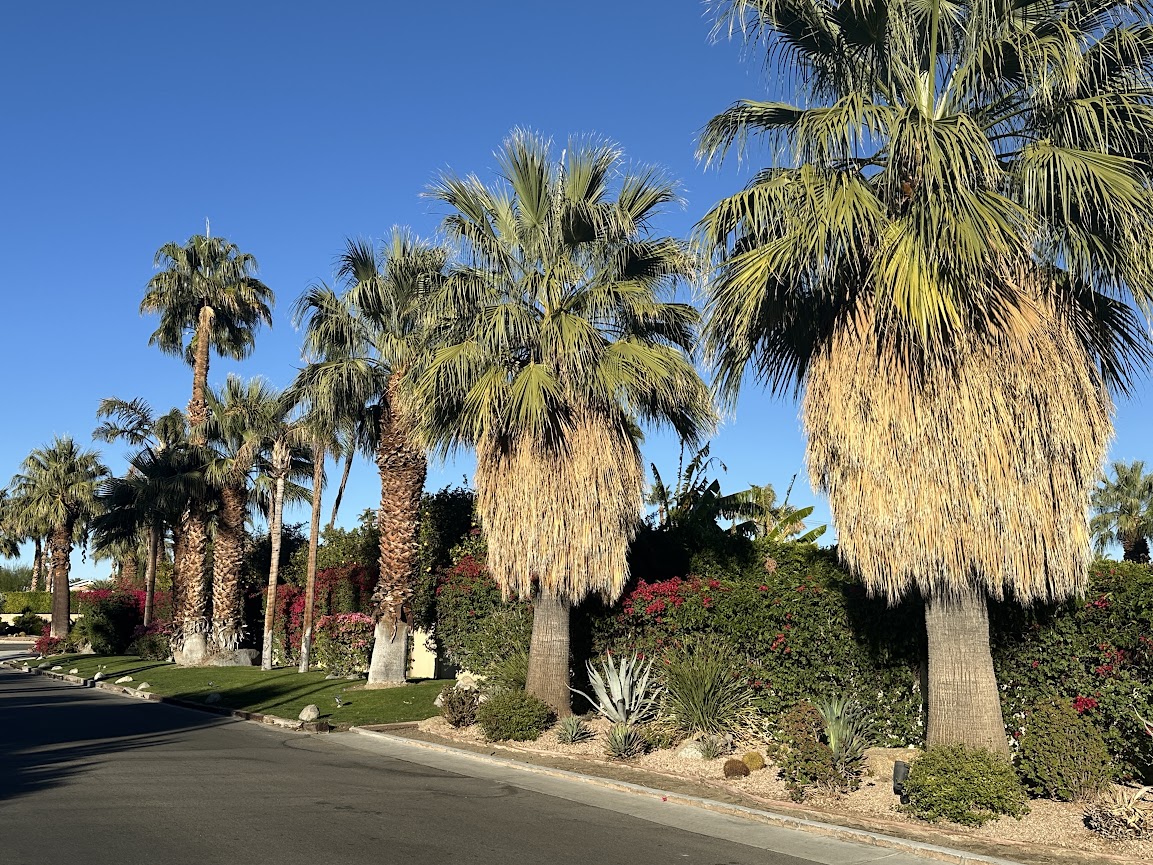
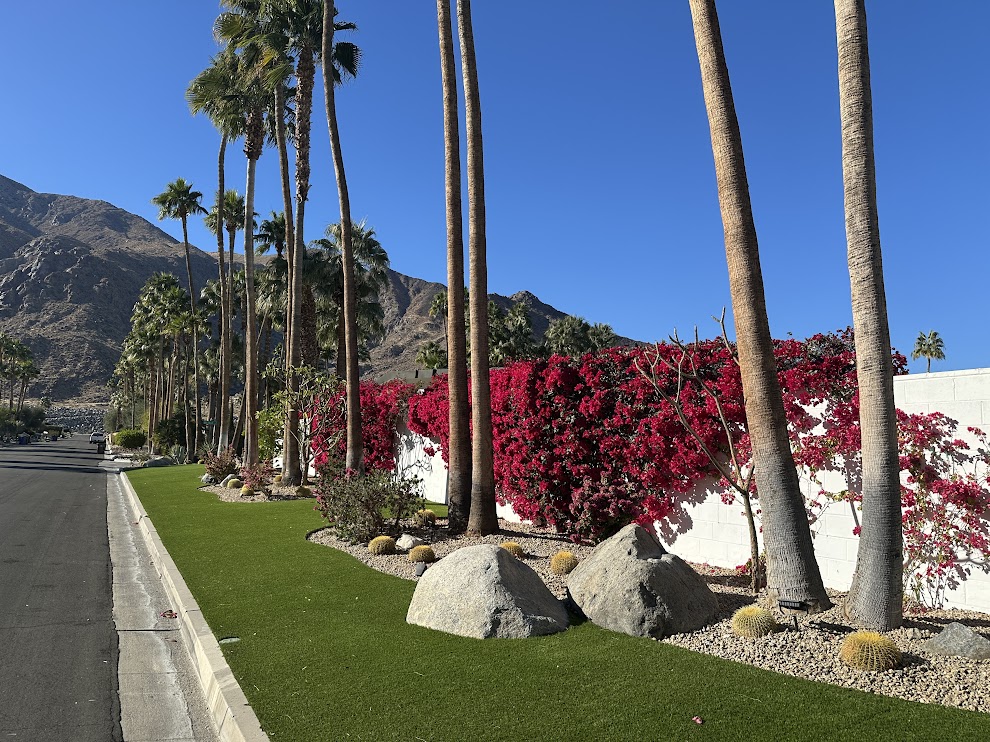
These enclosing walls serve a practical purpose, as many of these homes have housed celebrities like Kirk Douglas, Lucille Ball and Clark Gable, so it keeps out the lookie-loos like yours truly. The only portal are the gates, and they do come in all stripes.


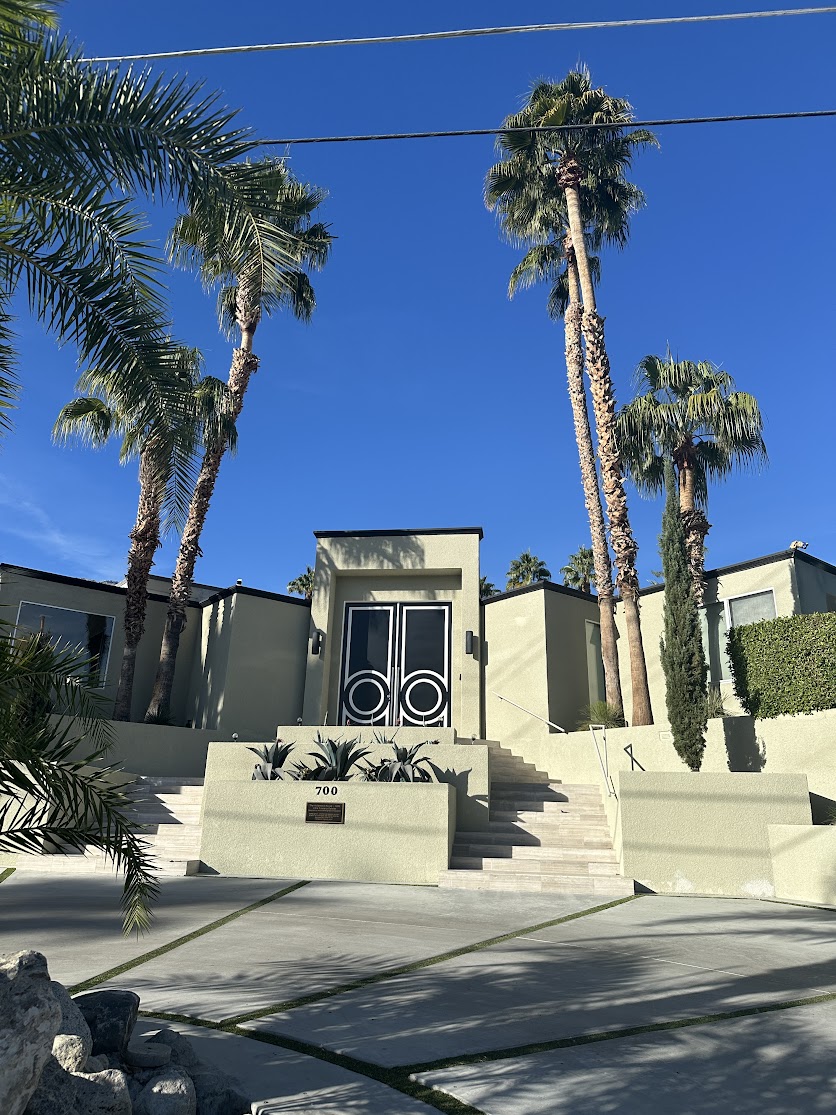
At Chino Canyon and West Panorama Road, the road begins to rise. This is the beginning of Little Tuscany, named because the early developers thought it reminded them of Italy. I suppose if you squint, one could see that. 700 West Panorama, from 1966 marks the transition between the two neighborhoods. It too leans heavily on the front door as its signature. It was designed by James McNaughton, a famed set designer and art director in Hollywood. This is a fine example of the Hollywood Regency style, a highly theatrical style rooted in the home’s interior. The exteriors often seem like an afterthought. It’s all about the front door., absurdly scaled, all the better to greet you with my dear. Home as theater.
I enjoy the background of who has lived in what house in Palm Springs, as it has been, and is, an eclectic mix. Case in point, across the street from the house above sits the Raymond Loewy house, at 600 West Panorama. The eponymous Mr. Loewy was a hugely successful mid-century industrial designer, who was responsible for the design of everything from the TWA logo to the re-design of coke bottles, Lucky Strike cigarette packaging to automobiles. This was planned as his bachelor pad, and he engaged one of the leading local architects of the time, Albert Frey, to design the pad in 1946. The site for this house sits on the first rise of the alluvial fan, and thus gives it great views of the valley. The bachelor pad included a pool that actually comes inside the house. One can just imagine those boozy bachelor weekends at such a setting; the pool illuminated at night, the tinkle of the cocktail shaker, city lights below.
And then he got married.


But again, none of this can be seen from the road, and this is the rub of some of these iconic homes. I once toured around LA with a friend, seeking out similar homes. We walked up the long driveway of a John Lautner masterpiece, and suddenly saw a black SUV drive up with barking dobermans and an ominous wave to follow the vehicle up the drive. We considered our options, flee or follow, and thought it best to follow. I remember thinking, this is it, this is how it ends- torn to shreds by dobermans because I just had to see in. Instead , whether it was our youthful enthusiasm as architecture students or shear luck, he happily let us tour the house. I am afraid I never learned from that episode.
As we head up the alluvial fan, next door to Mr. Loewy lived George Hearst, and it is said niece Patty Hearst recovered from her 70’s kidnapping at his home. Next to Hearst lived Frederick Lowe, of Lerner and Lowe, they the famed Broadway musical team (see Camelot, My Fair Lady). He retired to the desert from New York in 1960, where he is said to have rode horses, tended to his roses, and entertained his neighbors at the piano over martinis. The mind reels at this neighborhood’s cookouts.
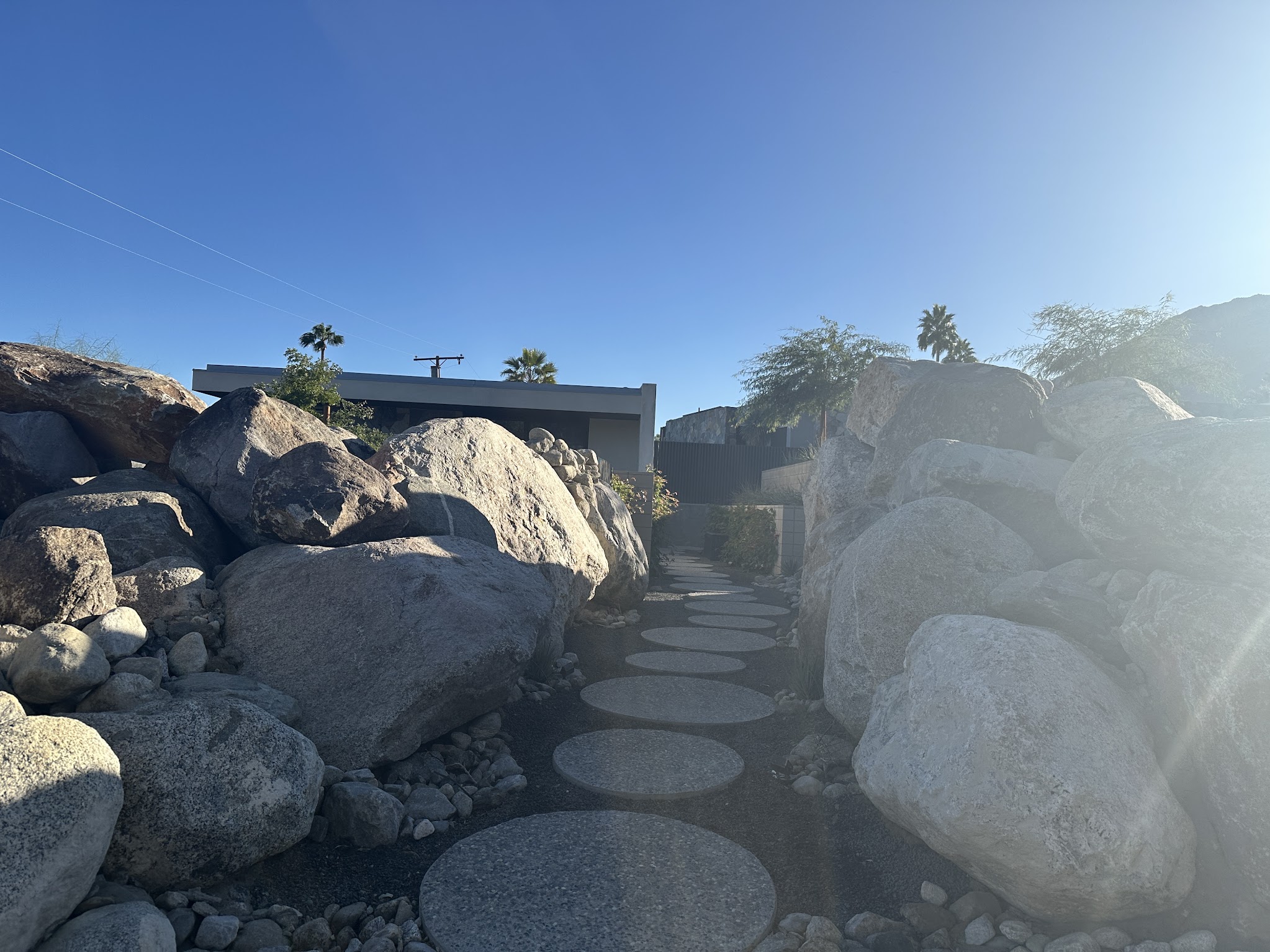
Back to the walk, and as one ascends the houses spread out as a torrent of boulders take over.
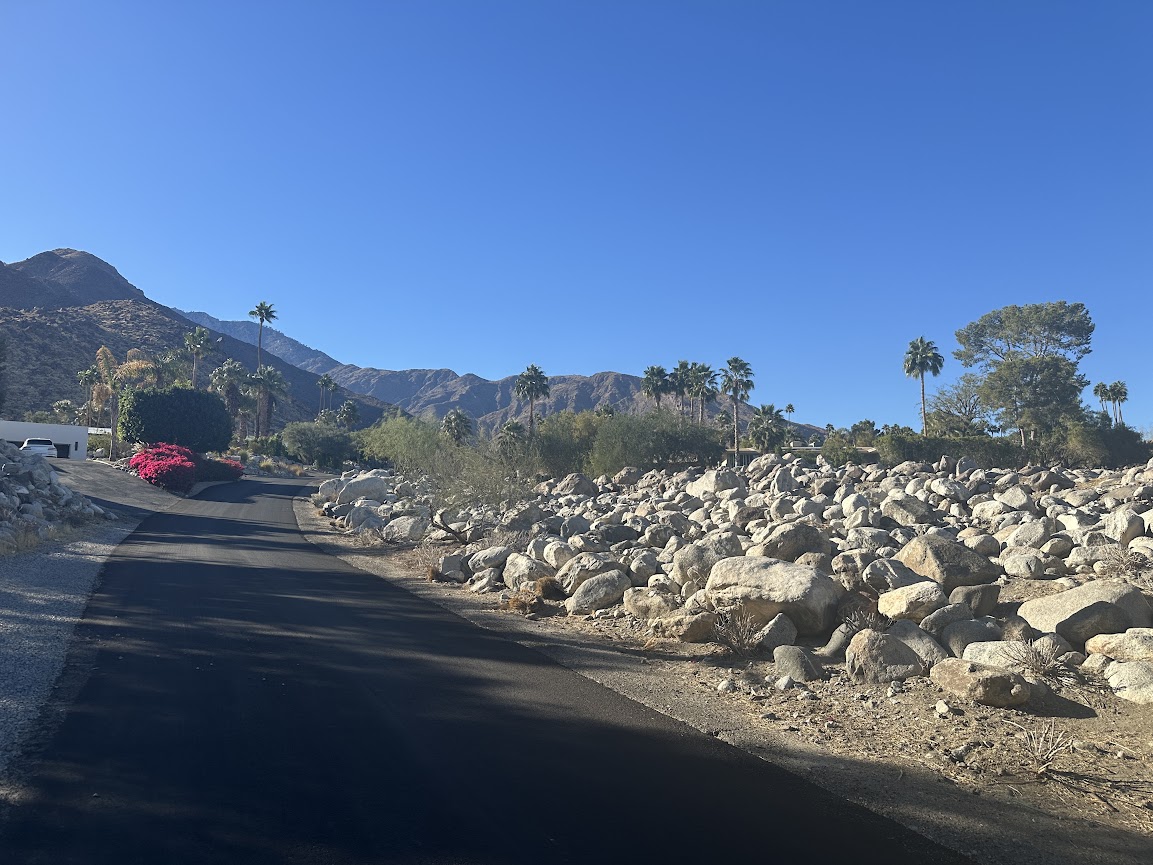
In some cases, the rocks nearly swallow the house.
At a bend in the road, we come to a home built for Dr. Franz Alexander, at West Panorama and Cielo Drive.. The plaque out front tells us he was the “father of American psychoanalysis, second only to Sigmund Freud in terms of his contributions to the profession”. One wonders if neighbor Patty Hearst was ever a client. Again, thinking of those neighborhood soirees.

The home was completed in 1954 , designed by Walter S. White. White was best known for developing a patent for his hyperbolic-paraboloid roof, a sort of “butterfly” roof. This home predates that, though clearly shows his emphasis on the roof as the big move, opening the view to the valley below.

Finally, at the top of Little Tuscany, at 1021 West Cielo, sits a home designed by famed LA modernist Craig Ellwood, built in 1971 for Max Palevsky. A Russian emigre, Palevsky was one of the original tech entrepreneurs turned venture capitalists. He founded a company that manufactured business computers in the 60s, then made a fortune when he sold it to Xerox. In the 70s, he became a chairman at Rolling Stone , saved it from ruin, became close friends with Hunter S. Thompson, became a champion of the arts, and helped found LACMA! And built this home.
In the late 60’s, inspired by travels in Morocco, he enlisted Ellwood to design a home that recalled the spartan whitewashed enclosures seen in his travels with Ellwood. A few of the published photos courtesy of US Modernist:


Again, we are left to imagine from the street. But I cauldn’t help but compare the classic magazine shot of the front of the house with my visit. Conclusion : Mr. Palevsky did not play basketball.


For a number of years, once past this last home, I could walk out into the rising desert landscape, a little used trail among the rocks, with stunning views back to the valley.
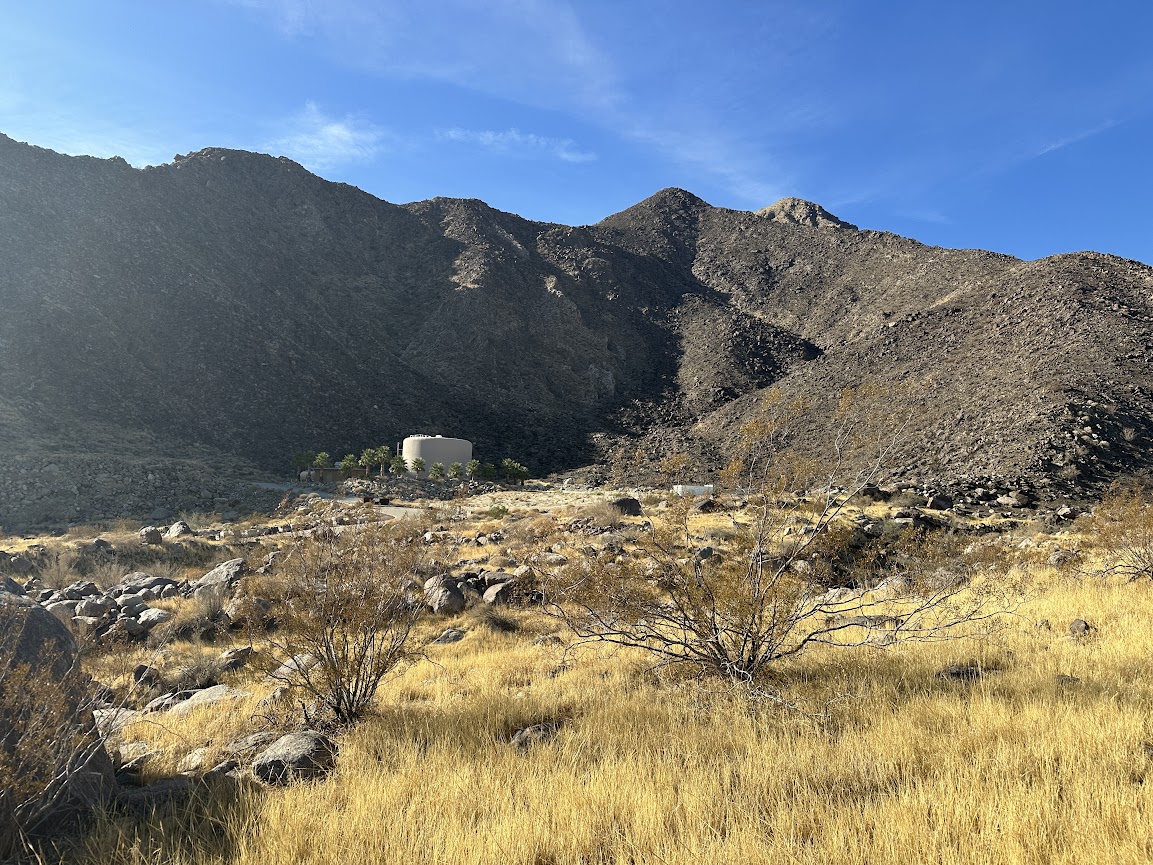

But alas, it is now being developed, and “Desert Palisades” now offers multi-million dollar plots to build those 21st century dream homes. Unlike the homes above, a number are speculative. The first “dream home” there has sat half finished for several years. The designer said the hell with the rocks and put it on a plinth.

Maybe that’s the problem. But nearby, a number of stunning new homes have been completed, including the last home designed by renowned LA Architect Ray Kappe. The home steps gracefully down the mountain, a tour de force of glass and steel. Built on spec. it sold for just under 5 million in 2023.
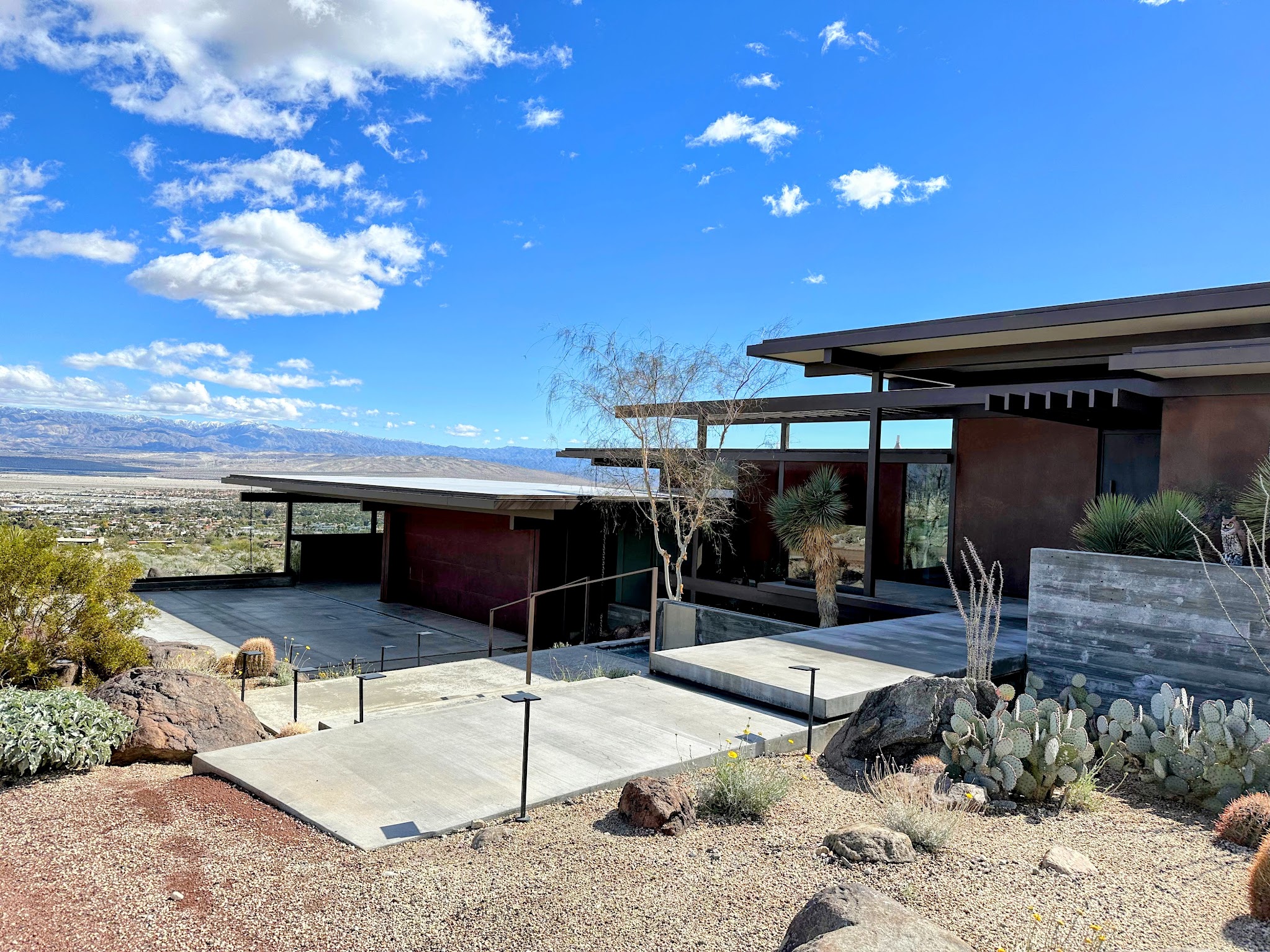

They have now restricted access through the development, so one can no longer get close to some of these spectacular homes. I have been accosted multiple times by the portly security guard who who thrusts a map in my hand each time. I am a repeat offender I have been told, and will try to do better. At least there are no dobermans.

So you can cut across the development to the Tramway Road. And if you are lucky in winter, perhaps it has snowed above and you get this scene.

So in the on-going evolution of our story, my husband and I like to imagine that we are the continuation of the grand Palm Springs snowbird tradition, albeit a far more humble version of that enjoyed by Douglas or Gable, Loewy or Hearst.
On the walk, one passes many plaques that tell of the social and architectural history of this landmark or that. Along the way, you pass a more humble home, hidden midst the rocks. It too has. a plaque:
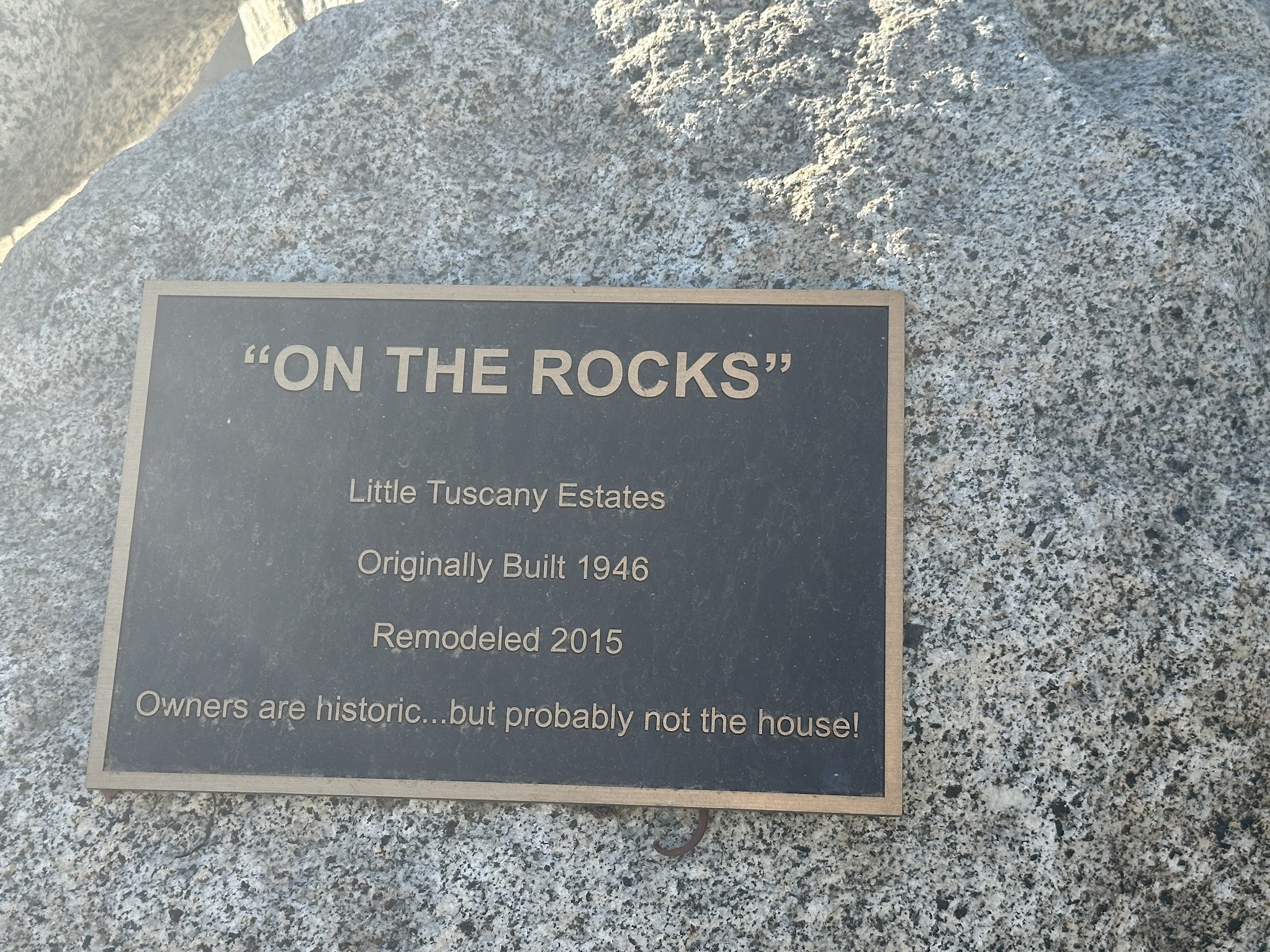
Now this particular shoe fits.
 urban ambles